Thursday, July 18, 2013

Roots + New Kids on the Block

And we're back!  Wow, I wish I was more computer savvy...

Anyway... summer!  Even though I don't always get breaks in the summer like I used to, I always think of them as being so much fun.  Fortunately, this summer I have quite a bit of free time, and better yet, I have my sister to come visit me!  Just in the last couple days, we've done some Santa Barbara, some spa, lots of shopping, and gotten sunburnt on the beach (much to my doctorly chagrin).  This past weekend, we saw an outdoor concert at the Hollywood Bowl -- if you've never been, my LA folks, go!  So with summertime concerts on my mind...

 
Roots:
I thought I would be really sad to pull out my tomato plant  which I had put so much blood, sweat, and tears into.  But it was actually a huge relief.  That tomato plant was stressing me out.

Anyway, once I pulled it, here's what I found -- a big ball of roots.  In the second photo, you can actually see how dense the roots got around the plant nanny that was stuck in the dirt there.  One of the primary issues with the plant was that I mistakenly put it in a too-small pot.  Here's what happens when you do that.  


Another interesting find whilst uprooting all the dead things was the dahlia tuber.  They are indeed tuberous.  If they had been healthy plants, I could've saved the tubers in a cool, dry place until next year and planted it indoors several weeks before planting it outside to regrow the same plant.  Here's what a dahlia's tuber looks like.  


New Kids on the Block:
Out with the old and in with the new.  As I mentioned in my last post, I've started getting more into cooking, in part with the help of a book called "Cooking for Geeks" (I've already learned a lot!).  One thing it mentions in the introduction is that the best and perhaps only way to learn to cook without burning out and quitting is to redefine success.  Instead of a perfect meal, success is having learned something, meaning that failure in the kitchen is a true success in the sense that it offers the most opportunity for learning.  I'm going to go ahead and say that applies to gardening as well.  And there is some joy to being able to pick out new and interesting plants.

So here's the newbies, good luck to you all.

Ptilotus "Joey"


An Australian native that I planted as a replacement for the tomato, this specific type of Ptilotus is an annual (meaning it will die at the end of the season), though perennials do exist.  It is touted as being very drought and heat resistant.  That's great!

It also has interesting cone shaped grey-pink flowers.


Yes, I instagram'd that.

Portulaca "Cupcake"


I picked this lovely plant because I loved the color with my tall yellow pot.  They will also theoretically slowly trail down the sides as they grow.


These plants are fleshy sun-lovers whose blooms open for a day in the sunlight and close forever at night.  Fortunately, there are a continuous crop of buds waiting to bloom each following day.  

Vinca


Also, known as the periwinkle, now's the time for these cute little flowers, often with differently colored centers.  I got them in an array of pink which I am partial to, and if all goes well, they will bloom through early fall.


These are also hardy plants with good heat and drought tolerances.

Maidenhair fern

One of my two hydrangeas died (the other one is doing great!).  So I replaced it by the relatively shady area next to the front door with this lovely fern, in part because my neighbor has a huge version of this plant and its leaves are just so delicate looking.


Ferns vary, but they generally lovely shady, moist areas (like forests).  They do not grow flowers but are grown for the fronds and reproduce by spores.  


How wonderful it is to have a whole new crop of plants growing rather than a bunch of dead plants judging me from outside...  I'm feeling optimistic!  

I leave you with a track that I dedicate to the scores of my LA friends who paid to see New Kids on the Block a week or two ago, you know who you are.  Here's the link.  (Yes, they are not only still around, but making new music...


Monday, July 15, 2013

An aside...
Having technical difficulties this week... <imagine some jeopardy-style music playing>

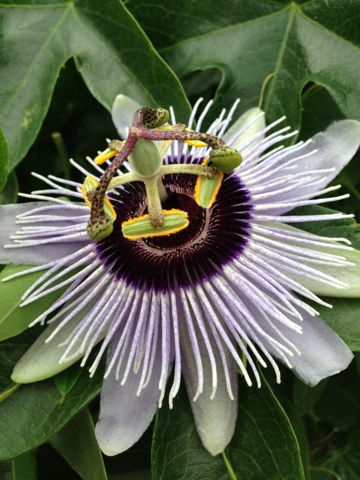
In the meantime, please enjoy this lovely flower I discovered at one of the Sawtelle nurseries: Passiflora, also known as Passion Flower...

Back soon!

Tuesday, July 9, 2013

Hot updates

Wow, it is HOT outside!  

True confessions:  when it gets really hot, my plants start looking like this:


...which makes me depressed to look at them, which makes me not go out there as much, which results in me neglecting my plants somewhat, which just worsens the whole situation.  It's a vicious cycle.

I've told you before about my habit of rapidly cycling through hobbies.  My husband who likes to make overly confident statements predicting my actions has said both that my garden "looks like it's in its dying cycle again" and that he thinks I will likely be "moving on soon from gardening."  ...thanks for the vote of confidence.

While I admit that my garden has looked somewhat ragged recently and I have eyed other interests I am planning on getting into with my new-found free time (namely cooking: I just bought "Cooking for Geeks" and am very excited about it as it approaches cooking from a scientific point of view), I am not intending on neglecting my garden, it's in my blood, people!  I've got a little bit longer, I've got a ways to go! (what a great song!)  So yes, here's some updates...

1. I am pronouncing the heirloom tomato project over, with an overall grade of D (not F because at least it did not die immediately). This is what the tomato looks like today:

*sigh*

I plan to pull it down later this afternoon (when it cools down a bit, my goodness!).  I really wanted to hold out hope.  My parents were here last weekend and helped me prune it and taught me about tapping on the stems with flowers to help stimulate pollination.  But this problem child has looked persistently out of control, Evan has complained persistently about what an eyesore it is, and despite being over 6 feet tall with many chances to have grown tomatoes by now, it has remained barren.  

Today, Evan also received a big bag of home grown tomatoes from someone lovely at work (thanks, Janice!). 


Upon seeing how prolific other people's tomatoes are, I'm saying, better luck next time and fare thee well in tomato heaven, Great White.

2. Not all things are terrible.  Here is a photo from today of the thriller filler spiller pot that I talked about in a recent post.  It looks great!  I will say the filler and spiller look somewhat more distinguishable in real life, but next time I may choose slightly more obviously different plants.  The Muehlenbeckia in particular has grown into a spectacular tangle of delicate little round leaves and the Fuchia has a number of beautiful flowers blooming constantly.


3. Our succulent science experiment is growing well.  Even the Crassula stem that I just tossed in there has sprouted roots and curved upward at the tip.  For comparison, here is the link to that first post.


4.  Actually, all my succulents are growing well.  I love succulents.  Pictured below is my gift succulent I've talked about before.  It's grown!

Also from Janice...  thank you!

5.  And lastly, to overcome this mid-summer gardening death depression, I went shopping today and-- surprise, surprise-- bought a number of new plants which I intend to plant tomorrow.  My sister is also coming to visit the day after tomorrow and her new man is joining next week, and naturally, I want to look like the green-thumbed gardener that I sometimes think that I am. So, lots of new and interesting plants (all heat and drought resistant!).  More later, but here's a preview of an exciting plant I had never seen before:

Ptilotus Joey (with Maidenhair Fern behind it)

And that is all for today.  Stay tuned and stay cool!

Tuesday, July 2, 2013

Hey Dahlia!

This week, I am dedicating my blog post to the wonderful, beautiful dahlia, since my planter of figaro dahlias has officially <cue music> bit the dust.  Of 6 total dahlias planted in various parts of my patios in various formats, only one remains semi-healthily alive (on the vertical planter) though flowerless.  Of the ones that did bloom, there was a hot pink, yellow, and peachy pink variety, all of which I've posted photos of before, and in honor of my poor dead dahlias, I will post again:


This was really my first foray into dahlia planting.  I personally like dahlias because not only are they beautiful, they also remind me of my opa who at one point behind his house in his hobby garden (as he also had greenhouses full of plants to sell in his working days) had a whole yard 10x12' plot of tall healthy vibrant dahlias.  I don't have a photo of his dahlias, so here's an old photo of me and Opa and Oma who are awesome:

yes, it's a photo of a photo... what?
I'm not the only one who loves dahlias though.  They are really popular!  If you venture over to www.dahlia.org, you will notice that there is a whole American Dahlia Society "Promoting and Supporting the Growing, Showing, and Enjoyment of Dahlias in North America".  It's a little nerdy and a lot awesome at the same time.  These people aren't messing around!

1st Place: Peg & Emory Paul
A Dahlia Society photo contest winner

But back to the popularity of the dahlia, similar to roses, there is a huge amount of variety.  Dahlias originated in Latin American and since then have been hybridized into an enormously diverse group of flowers "in all colors but true blue" (says the Sunset Western Garden Book).  Big, small, lots of petals, just a few petals, round, spiky, tall, bushy... you name it, you got a dahlia of your choosing.  Unless you're really into blue flowers.

Technically, they are perennials that grow from tubers that you can dig up at the end of the year and keep for the following year.  (If you're me, you buy them as a baby plant and then they die and you never see the tuber...)  Plant them in full sun unless you live in the Valley where it is hot as death in which case part shade is better and water regularly.  Different sources say different things, but regular fertilizing while blooming is probably good practice.  And bloom they will, from mid-summer to first frost.  To show off your hard work indoors, pick nearly mature flowers in the morning and stand them in a few inches of warm to hot water for several hours after which point they should be good to go for display.

As for the demise of the dahlia, there are the usual issues (over or under-watering, root rot, too hot/cold, and general neglect) and there are one or two others.  I have noticed that tall dahlias tend to fall down a lot without support, much like my problem child heirloom tomato.  But my dahlias are not tall.  Nope, the death of my dahlias was, I suspect, the dahlia mosaic virus.  Yes!  Can you believe there is a specific virus that infects dahlias?  (There are actually around 12 such viruses).  The virus spreads slowly via their vector, the aphid (again with the aphids!).  The result is weird patterns, yellow spots, stunting, and distorted leaves.  Other viruses can cause leaf necrosis (ie, leaf death).  And another common problem that looks the same is the red spider mite, difficult to see without magnification.  I am not entirely sure what killed my dahlias, but here is what happened, and it slowly spread from one plant to another like a virus...  

Early effects

Later... still blooming, but yikes

So that's that.  Dahlias, it's been lovely.  I leave you with some floral eye candy of the darling dahlia.


red-white-dahlia.jpg

File:Dahlia Moonfire 2.jpg


Dahlia Dahlia Decasplit Myrtles Folly from Longfield Gardens

Yes, they are all dahlias!  And lest I break some copyright law (seriously someone tell me if I'm breaking the law... I am but a newbie blogger!), the source links are herehere, here, here, and here, respectively.  Happy gardening!

Saturday, June 22, 2013

The Pretty Pot: "Thriller Filler Spiller"

Recently, Evan asked if i might plant something nice by our front door.  Obviously, the answer was yes.  This afforded me the opportunity to buy new plants, explore the world of shade plants, and also come up with a pretty display pot.  It is an art, if you let it be one.

So how do you pick the perfect pot of plant?  First there's the pot, which I won't say much about.  You need to consider your space which affects the size, shape, and color of pot you will choose.  There are also a variety of types of pots available -- ceramic, plastic, terracotta, metal, wood...  it's a topic we can cover another day.  

Then there's the type of plant which will grow well in your pot.  What is the microclimate of the pot's location?  Sun, part sun, shade?  Is the pot one that will dry out quickly?  Is it very hot or windy?  All things that will narrow down your plant selection, and thank goodness, because I have a hard time choosing regardless.

What I really want to talk about is something that is not a new concept in the garden world:  "Thriller, Filler, Spiller"... which makes me inevitably think of Bob Marley singing "Iron, Lion, Zion" every time.  It's a cheesy name that kind of sucks, in my opinion, but I must give credit where credit is due, sort of...  I did not come up with this concept.  But really, neither did the garden world.  It's kind of like the background, middleground, and foreground in art.  In essence, you want something eye-catching and tall in the back, something fairly leafy and space-filling of medium height in the middle, and something short and ideally trailing in the front.

Enough words, let's do some pictures:


Having just been to Italy, I picked a plastic (lightweight!) pot with a Tuscan-esque design and color on a stand to bring the small plants closer to eye level.  

Then I picked my thriller, which was easy -- I have thought fuchsia plants were gorgeous since I saw them in my aunt's garden in Holland.  They do have a proclivity towards developing mites, but I am pre-armed with spray.


It was much more difficult to pick the other plants.  After more than 30min of walking back and forth at Armstrong in indecision, for the filler, I picked Variegated Helichrysum and for the spiller, I chose Muehlenbeckia.


Why?  I wanted a variety of colors and shapes of foliage.  I thought the Helichysum was a nice contrast with the silvery light green that also matched the accent color of our apartment.  Also, the Muehlenbeckia had nice small leaves in a tangle of dark green to contrast the other two plants.  


I absolutely love the fuschia so I stuck with other leafy plants so that other larger flowers wouldn't detract from the delicate look of the fuschia flowers.  But there are tons of options.  Perhaps in another pot, one could do pink impatiens with trailing ivy with a tall purple leafy plant of some sort in the back.  Here's a few examples from the web (Sources linked here: 1st, 2nd, 3rd, 4th):


And they are all beautiful and different in style!  I have noticed that other people (at least on the interwebs) tend to plant their pots significantly tighter than mine.  How do their plants have space to grow?  Anyway, I planted this pot about 1 month ago, so it is slowly filling out beautifully.  Updated photos to follow!  And remember, next time, you want to plant a pretty pot, think "Thriller, Filler, Spiller"  (or Iron, Lion, Zion).  Happy planting!

In baby stage, welcoming guests


Wednesday, June 19, 2013

Invention convention

What??  Has it really been over a week since I last posted anything?  Unbelievable!  Well, it has been a busy time...  I am a mere SIX shifts away from completing residency and thereby finishing my lifelong (since preschool to be exact) journey through school and training.  A long road it has been, and here, where the road forks, is an exciting, exhilarating place.  Not so exhilarating that I would ever forget my lovely garden though.

So when I was in 4th grade, I won Invention Convention in my class and went to the school-wide level (where I did not win, but hey).  It was a crowning achievement for me, to the degree that I still talk about it with slightly odd frequency and take it as a sign of wonderful things ahead (I'm talking destiny).  Anyway, I invented a "Bug Smasher-and-Picker-Upper" which was a long handled wooden block attached by a spring to an equally long handled flat piece of pliable board below, such that you could trap an insect, demonstrated by an origami square with a roach drawn on top, by laying the pliable board on top and then squeeze the handle, causing the block to smash on top of the board/bug.  Then you could scoop up the bug on the board (it was very thin) and toss it in the trash.  I hated bugs.  Still do.  And that invention was ingenious.

Anyway, fast forward to 2013, I am stuck with the problem of a vertical planter that kills all my plants because it dries everything out.  And it killed half my plants while we were in Italy.  So I decided to try to fix it, somewhat crudely.

This was square 1, ie, my planter about 1mo ago, post-trip, pre-plants:


Clearly the Dipladenia (top left, red flowers) is a superhero plant because it has managed to grow through all forms of hardship since last fall, despite being an annual.  Aside from that, though, nothing has managed to grow successfully in the top two rows all because of the dryness.  Simple solution:  Figure out how to retain water...

Plastic bag lining!  Fancy!

A bit crude perhaps, but a way of keeping moisture from evaporating out the sides.  I did this on the top right and middle left.  And as a separate mini-experiment, on the middle right, instead of using plastic bags, I added a Plant Nanny with a water globe, which I had previously stuck in the dirt with my dahlias, where it was useless -- all of the water would immediately drain out the bottom in 2 minutes or less, rather than seeping slowly as the advertising insinuates it will.


Row 1:  Dipladenia, Marigold (1).  Row 2:  Marigolds (x2), thyme.  Row 3: Figaro Dahlia, Spearmint.  This is maybe the oh, 5th, incarnation of this vertical planter...  And a
bout a month later, through a bit of hot weather as well, we have the following results:


Looking pretty good!  Okay, so not an invention, per se, but still a solution with results I am happy with.  Both the plastic lining and the plant nanny/water globe combo seem to be helping.  Of course, there are the variables that marigolds are pretty awesome in terms of hardiness.  That's why you see them literally everywhere -- they're easy to grow.  Thyme isn't so fragile either.  But still... not bad!  So let's hope that the 5th time's a charm!

Tuesday, June 11, 2013

Quick tips for cut flowers

Don't you hate it when you buy flowers and they seem to die instantly?  Here are a couple tips to help with that.

Quick tip of the day #1 -- Trimming the stems:
First off, don't just stick your bouquet in the water.  You need to cut the stems at a 45 degree angle.  A Dutch family trick is to also make an additional cut 1-2cm directly up the length of the stem from the bottom.  All of this exposes more of the water-absorbing portion of the stem to the water.  You also need to trim off any leafy debris and extra stems below where the water line will be.  Otherwise, they will decay and shorten your flowers' life.

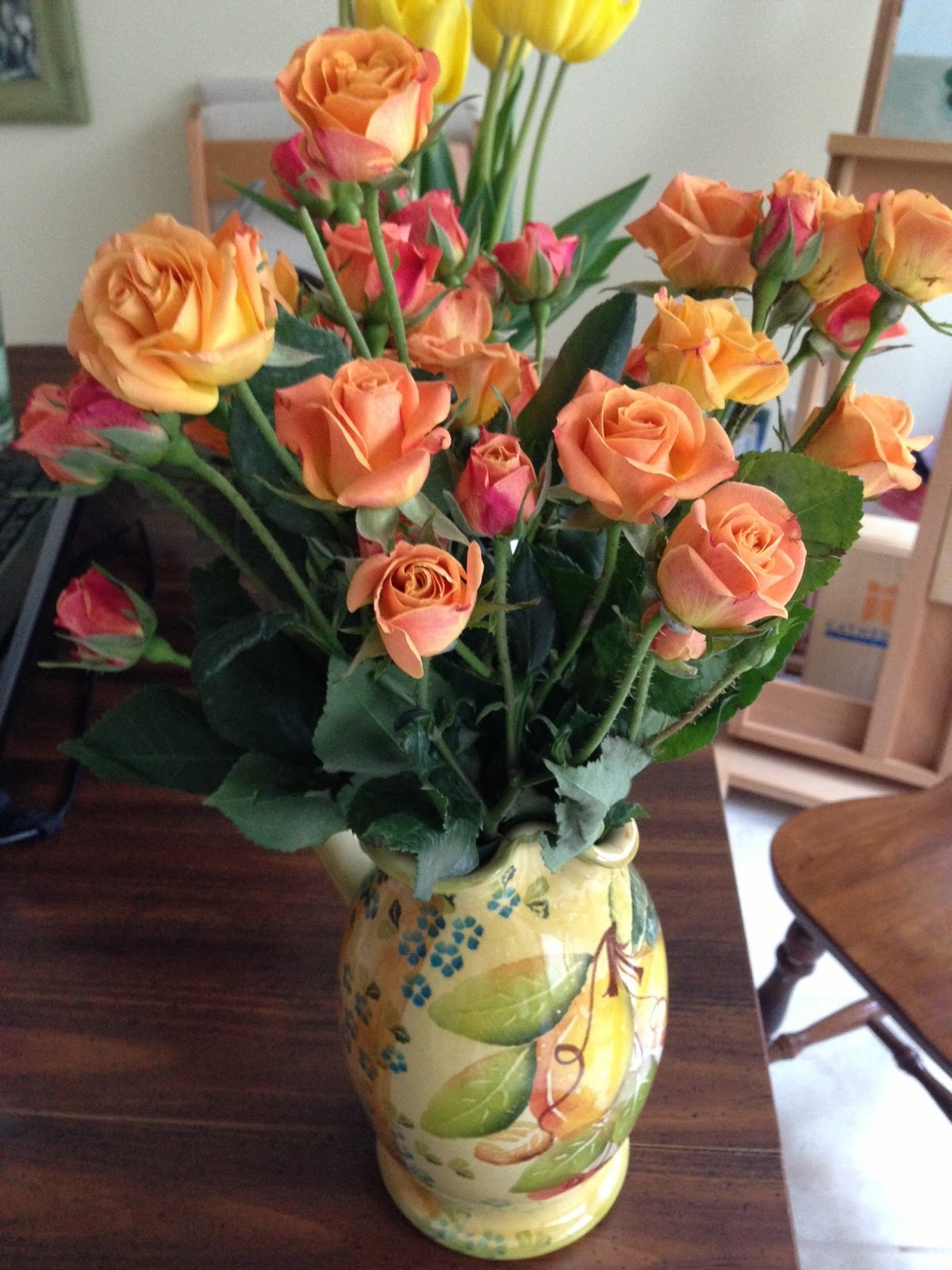
Spray roses

Quick tip of the day #2 -- Conditioning the flowers:
To keep your flowers standing up straight, when you buy them put them in water for 4 hours after trimming the stems but before taking off the wrapping so that they are propped up straight in the vase.  After 4 hours, remove the wrapping, and your flowers will be in good shape!  You will notice the difference with flowers with softer stems such as tulips which have a tendency to droop at the stem when they wilt.

Tulips!

Quick tip of the day #3 -- Additives:
I've heard (and tried) everything from adding Sprite, pennies, and straight sugar to the water in order to extend the life of my bouquets.  None of those worked and I have personally had better experience with just plain water.  But some sources suggest additives both to feed the plant and also kill any bacteria.  That's why sometimes flowers come with little flower food/preservative packets attached.  If there is no handy packet, you can try this little recipe, provided by the UCDavis Division Agriculture and Natural Resources (scale up or down as needed):
Flower food/preservative:
2 Tablespoons lemon juice
1 Tablespoon sugar
1/4 teaspoon bleach
in 1 quart of water

Make sure to replenish the water regularly and if you notice any gross moldy-type consistency, then completely replace the water, trimming the stems and cleaning the vase again before putting the flowers back in the vase


The flowers pictured are both bouquets from the party we had this weekend, now on day 3 of being in a vase.  As you can see, we are kind of obsessed with painted ceramic pitchers at the moment, both procured during our trip to Italy... pitchers make great vases!  (That is a decorating tip from Evan, my interior decorator/husband)