Showing posts with label aphids. Show all posts

Monday, May 12, 2014

Good Bad Ugly

I hope you have had a wonderful mother's day weekend!  It's been a busy few weeks for me -- first, I had the most wonderful visit from my siblings which we combined with a little trip to Vegas (always fun!) and then it was back to work.  And I have to be honest, the last few days of work have left me totally wiped.  So today was the first day I had to really take a close look at what's going on in my garden.  Being the type that saves the best for last like the dutiful hard-working child I was raised to be, I'll go a bit out of order for this:

BAD:

Fuchsia -- Okay, from afar it looks alright, good even.  I am pleased with the bushiness of the plant (in contrast to an overly tall skinny plant last year).


But the aphid wars continue.  I have admittedly only used the insecticidal soap once, in part because that spot on the front stoop has become sunnier than it used to be and I don't want to risk burning the leaves by spraying at the wrong time of day. 


The result, as you can see, is that the aphids target the new growth (flower buds) which causes the blooms to deform at best...


And not even open at worst.  

Attempted solution:  continue insecticidal soap, rotate with Neem.


Begonia -- *sigh*  Mold.  Specifically Botrytis Blight, according to Google.  


A quick synopsis:  It is a fungal infection of the plant which characteristically looks like my picture above, causing mushy brown-grey dead parts.  Optimal conditions for growing this mold, if that is your goal, include high humidity and crowding plants creating poor air circulation (gulp... guilty).  Recommendations to avoid include removing dead plant parts and watering early in the day to ensure the plants are as dry as possible.  Here is a great summary.  

I think this issue began when I planted the begonias and the leaves were touching the dirt which I watered heavily in the beginning.  Those were the first leaves to go and since then, the problem has been slowly worsening.

Attempted solution:  remove all infected leaves even if only a few leaves remain to try to spare what's left of the plants


UGLY:

Sweet jessamine -- It seems that the life span of these climbing plants is only 2 years (recall what happened to my poor jasmine plant) before huge chunks of it die.


Is it possible that this is yet another case of root rot?  Is there a root ball in the bottom of this pot?  Are these climbing plants just not meant to be grown in pots?  (As a gardening guru once told me, "lots of growth on top means lots of growth in the ground" ...except my patio only has space-limited pots)

Either way, I have been keeping an eye on this for awhile and it seems to be a lost cause... this plant is D-E-A-D (well, pretty much).


GOOD!:

Many good things!  I'll keep this succinct and let the pictures do the talking.

Tomato -- It has already grown a lot


Which I found alarming, given what happened with my heirloom tomato last year (HUGE, no tomatoes), until I saw this:


Hooray!


Geraniums -- Glorious


Hydrangeas -- have not mentioned these in a long while!  Well, let's just say there's this:

Tiny flower buds...


More on this to come as we watch and see what happens.


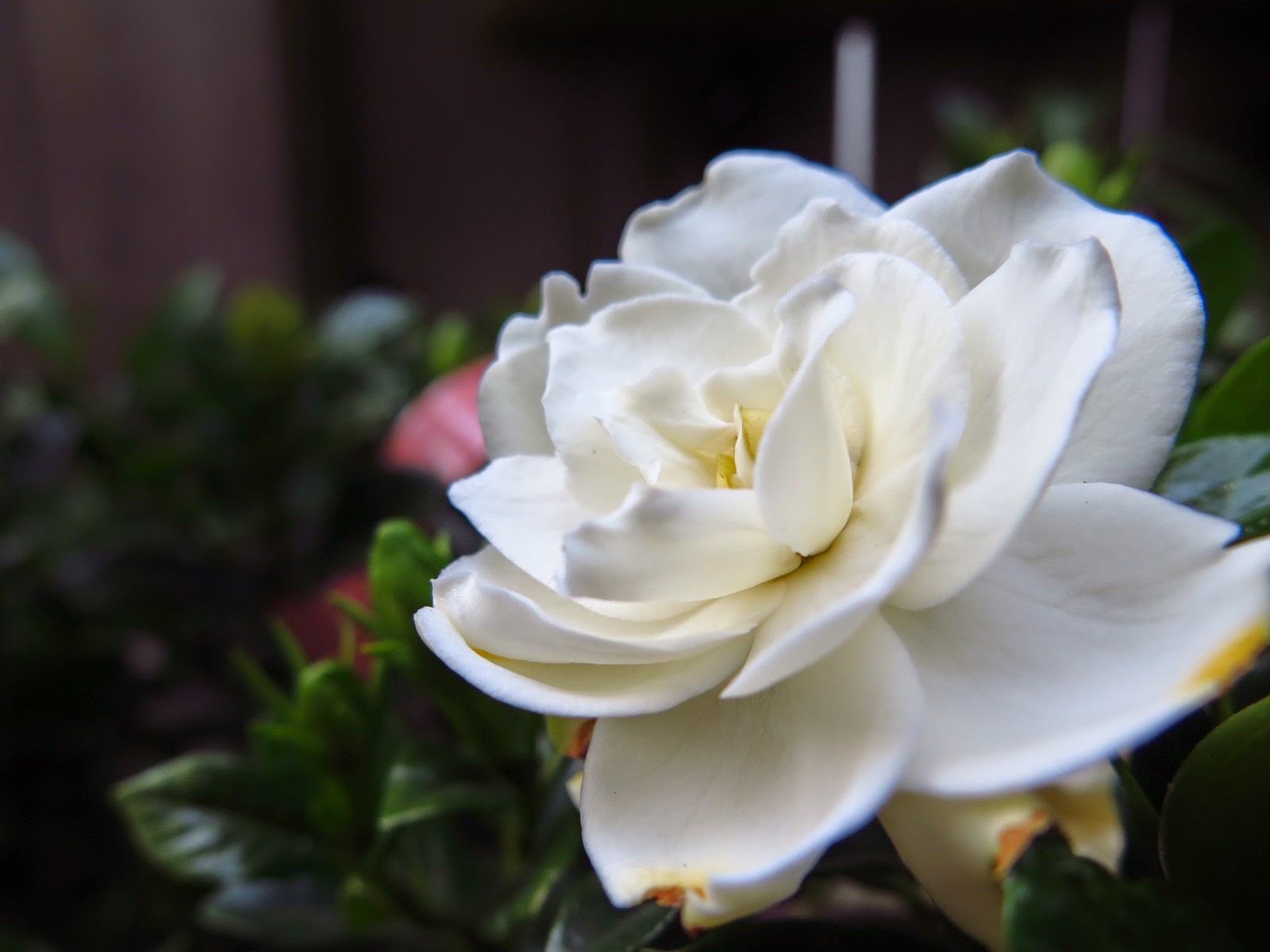
Gardenia -- New addition to the garden!  Thank you Olivia for the birthday gift!  It smells wonderful!  Later this week, I will be buying a nice new pot to put it in.


Definitely more good than bad in the garden... I'm smiling.  Have a beautiful week!

An aside:  A must watch if you have not already seen it...  Kevin Durant's MVP speech


Monday, March 3, 2014

Blooming Succulents! (Part 2)

I would say that I post this at the risk of seeming succulent obsessed, but....  let's be honest, I AM succulent obsessed!  Maybe you remember my last post about blooming succulents (here it is, if you would like to refresh your memory).  We had a few succulents that held promise of blooms, what they would look like, heaven only knew:

Our Aeonium with the "hat":


Our gift Echeveria with a tiny bloom stalk:


Well, this has certainly been the season of yellow for my garden.  Starting with the Aeonium, it has turned into quite the long-lasting pretty yellow "hat".  I had wondered if the Aeonium was truly "monocarpic," meaning a plant that flowers, makes seeds, and then dies, rather than re-flowering.


As you can tell, it is -- pretty much all that is left of the plant below the flower is dead leaves.  But the lovely little blooms are a nice gift.  As you can see, the other stalk has grown a side stalk too, so we will see what happens from there.


As for the Echeveria, it too has made some progress.  


This picture shows three bloom stalks, but on my visit to this little plant in my garden, it now has even one more stalk.  Blooming like crazy!


They too are long-lasting yellow flowers, little bells.  They have been blooming slowly, in the pattern of so many stalks of flowers where the most proximal flowers blooms first and then die while buds at the tip have yet to be opened.


The last focal point of interest is gross but fascinating.  If you know me in the context of my garden, you know that I absolutely hate aphids.  (Aphids and green worms... don't even get me started...)  But this is interesting -- look closely:


They're yellow!  What??  I had to investigate.  So it turns out that pea aphids come in several different colors (red, green, pink, yellow...).  Their color comes from carotenoids (like the beta-carotene in carrots that makes them orange).  Interestingly enough, generally animals don't make carotenoids but pea aphids are an exception -- they have the genes to make carotenoids and therefore different colors, the first known to do so, in fact.  An even more interestingly, they appear to have gained that ability by "stealing" the gene from fungi that they eat, via lateral gene transfer.  Color is important to pea aphids because it affects which predators eat them (ladybugs eat red aphids, wasps attack green ones).  The red and green colors originate from these genes, and yellow appears to be a mutation.  If you're interested, here is a story on NPR and another more in depth story on Science Daily.

Who knew my little enemies could be so interesting.  If you listen to the NPR article, the lady studying them actually describes them as "cute"... that's a stretch.

I hope you are staying dry in our LA monsoon.  This week, I have been feeling good, and I leave you with this song that I am currently loving which will leave you feeling good too:  Pharrell "Happy".  May you have a week full of happiness!

Thursday, April 25, 2013

Oh, the places we'll go

Would you believe that I dreamt last night that giant aphids terrorized my herbs to the point that everything died?  What a weirdo.  (Although I am pleased to report that Michelle's modified aphid spray works!  It requires repeat applications, but the number of aphids is significantly diminished.)  

Anyway, Evan and I are leaving for Holland and Italy tomorrow and I am very excited about all the wonderful things we will get to see.  My oma told my dad that they had a cold winter this year so all of the tulips are blooming a little later... so we'll make it just in time to see everything in full bloom!

(Thank you lonely planet for this image)
We also intend to see at least one glorious garden (Keukenhof!) while we're on our trip.  I will come back with pictures.  Until then, tot ziens and arrivederci! 

Sunday, April 21, 2013

Aphid Attack!

Yesterday, I went into my garden to take a look at how things were going.  I noticed my string of pearls has been rid of its mildew.  Hooray.  My parsley's whitefly problem is also greatly diminished with what appears to be numerous dead whiteflies on the dirt next to the plant.  Hooray again.  BUT as I looked closer, I saw that the whitefly in 3 days time has been replaced by... WHAT IS THIS??... APHIDS?!  


I gag.  Aphids to me are one of the most disgusting creatures alive, second only to the more disgusting cockroach. They hang out in huge groups on plants' stems and leaves literally sucking the life out of them to the point you would never even think of wanting to eat that plant.  Lest you think, "That picture looks awfully similar to the whitefly picture."  The main differences are, 1: they're bigger, about 3mm each  2: they're green (or sometimes black)  3: they're plump little pests  4: they don't fly.

Naturally, my next thoughts were how best to kill every single last one of these aphids.  For me, serious pesticides are out because I plan to eat this plant.  Even Neem oil which is pretty organic (it has medicinal uses) which I love in small doses is not something I really want to douse my plant in -- some sources mention studies that show that at least one of the component chemicals can in large doses cause temporary infertility.  Yikes.  

Fortunately, there are some easy organic home remedies that you can make yourself in no time at all -- garlic oil spray, tomato leaf spray, dish soap + water spray... the list goes on (here and here are a couple sources).  After looking at a couple sources, I decided to combine components of several for what I hope will be maximal killing effectiveness.

Michelle's modified aphid spray
You will need:
3-4 garlic cloves 
A small handful of tomato leaves
1 teaspoon cayenne pepper
2 tablespoons oil
500mL water
A spray bottle

Cut the garlic into a few smaller pieces.  Put the garlic and the cayenne pepper in the water and bring to boil.  Then toss in your tomato leaves.  Continue to boil for a few minutes and then lower the heat and let it all simmer together for another 20-30 minutes.  Let cool.  Remove the garlic and leaves, then add your oil.  Your aphid spray is complete.

Simmering aphid killing spray
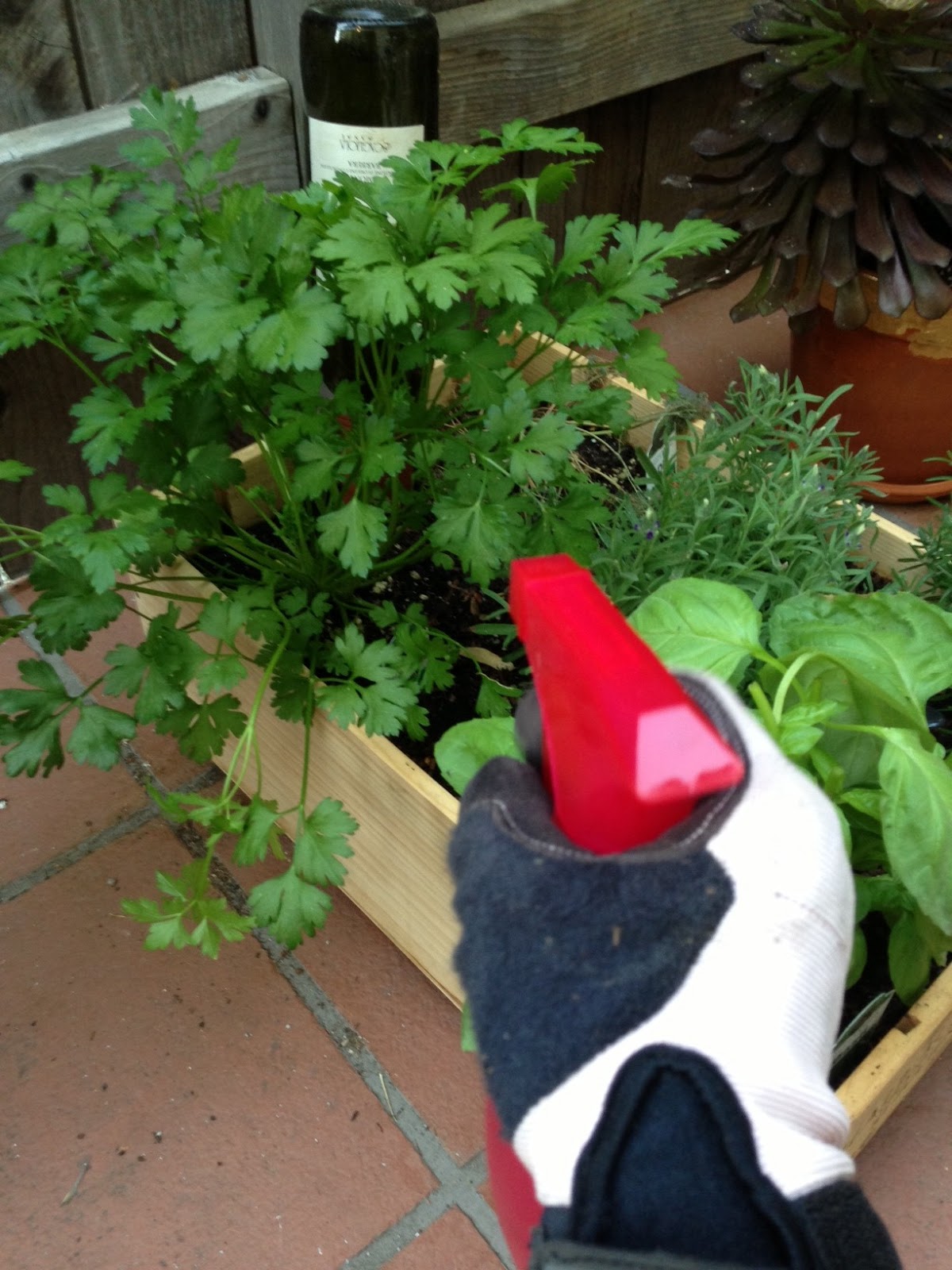
Once you're done, fill the spray bottle with your aphid killer spray, shake and spray the crap out of your plant.  Actually you should probably do a test spot first, but being too impatient for that and knowing that aphids increase in multiples of 80 per week, I decided to forgo the test spot and trust in the fortitude of my parsley.

Die, assholes
We will see if this spray actually works.  I feel like oftentimes, pests scoff at these organic home remedies, "Please, woman. Garlic scented water?"  I will keep you updated.  

On the upside, I harvested my first herb crop of the year... it is quite beautiful.  (Nevermind that I spent about 35 minutes de-pesting my parsley with a leaf by leaf examination.  *sigh*)

Beautiful herbs!